
None
Fly Quiet Program
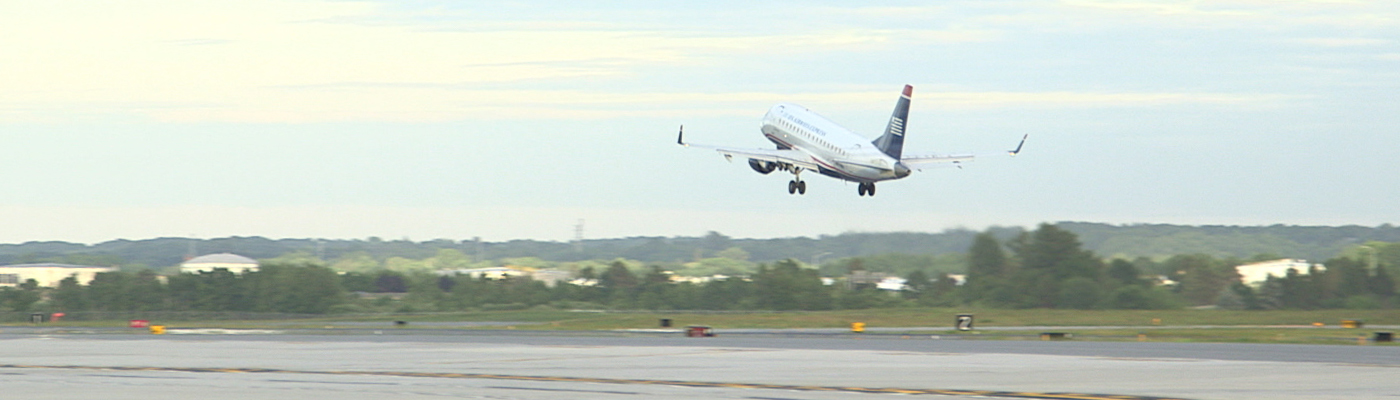
This voluntary program is designed to encourage aircraft operators to use "fly quiet" flight patterns and procedures that reduce noise in the communities surrounding Portland International Jetport. Weather conditions at time of flight determine if a flight is eliglble to use Fly Quiet patterns and procedures, and any flight in noncompliance is included in Noncompliance Reports sent semi-monthly to the local Air Traffic Control Tower and Noise Advisory Committee for review. Although flight behavior is at the discretion of the pilot and the air traffic controller, these reports are used to identify ways to encourage and increase compliance of our noise-mitigating flight patterns and procedures.
Next Noise Advisory Committee Meeting:
***Open to the Public***
To be announced
Agenda
PWM Main Conference Room and Hybrid
Passcode: 352408
Or One tap mobile :
+13052241968,,86831716355#,,,,*352408# US
+13092053325,,86831716355#,,,,*352408# US
Or Telephone:
Dial(for higher quality, dial a number based on your current location):
+1 305 224 1968 US
+1 309 205 3325 US
+1 312 626 6799 US (Chicago)
+1 646 931 3860 US
+1 929 205 6099 US (New York)
+1 301 715 8592 US (Washington DC)
Webinar ID: 868 3171
New Flight Procedures being developed by Jetport
A new instrument flight procedure is being developed that will help keep planes over water, and it should be available to airlines by January 2026. This goal of this procedure is to remove the RNAV Visual approach over Peaks Island and to reduce the number of daytime and nighttime flights using the ILS approach over South Portland.
Understanding Flight Compliance/Noncompliance
2024 PARAMETER TABLE
MAPS-VIRTUAL GATES
REPORT DESCRIPTIONS
COMPLIANCE SUMMARY Explained
ARRIVAL FLIGHT TRACKS Example
DEPARTURE FLIGHT TRACKS Example
The Noise Abatement Program identified which flight procedures to use for noise mitigation and the required weather minimums for their use, and the Jetport has drawn a flight tolerance corridor that will account for variances in the precision and accuracy of a flight track with the aircraft and technology that is available. (The flight tolerance corridor will become narrower as new technology is developed.) Time of day and weather conditions around the Jetport determine when a flight is eligible to use these noise mitigating procedures. A flight that is eligible is considered noncompliant when it fails to use the procedure and stay within the flight tolerance corridor. Looking at the map below, any flight that departs to the east is considered noncompliant if it does not stay within the red lines of the tolerance corridor, and any flight arriving from the east when weather conditions allow use of an over-water procedure is considered noncompliant if it crosses any of the three red lines.
Monitoring Flight Noncompliance
The Jetport actively monitors compliance of flights using the established noise mitigation procedures during the noise sensitive hours of 10pm-7am and for flights operating east of the Jetport. Each flight taking a track over residential areas when it could have been avoided is included on a Flight Noncompliance Report and will trigger a review by Operations and the Tower. These lists are designed to replace the need for submitting noise event complaints. Noncompliance trends are discussed at Noise Advisory Committee meetings.
Link to Noncompliance Report Packages
2026 Year to Date | Charts
September 2026 | 01-15 Monitor | 16-30 Monitor
August 2026 | 01-15 Monitor | 16-31 Monitor
July 2026 | 01-15 Monitor | 16-31 Monitor
June 2026 | 01-15 Monitor | 16-30 Monitor
May 2026 | 01-15 Monitor | 16-31 Monitor
April 2026 | 01-15 Monitor | 16-30 Monitor
March 2026 | 01-15 Monitor | 16-31 Monitor
February 2026 | 01-15 Monitor | 16-28 Monitor
January 2026 | 01-15 Monitor | 16-31 Monitor
December 2025 | Charts | Monitor | Analyze | Data Issues
Generated semi-monthly and include the following reports:
NSH NONCOMPLIANT – 10pm-7am Preferred Runway Noncompliance
NONCOMPLIANT ARRIVALS OVER LAND – When HVA/RNP Eligible or RNP Eligible (after RNP active)
ARRIVALS OVER PEAKS – When HVA/RNP Eligible or RNP Eligible (after RNP active)
EARLY NORTH/SOUTH TURNS – Departures from Runway 11 making early turn (1) North or (2) South
RUNWAY 18/36 – When Expected Runway 11/29
NOTE: Until the new over water instrument procedure (RNP) is implemented and active, only the flights listed for NONCOMPLIANT ARRIVALS OVER LAND – When HVA/RNP Eligible will be reviewed. The ARRIVALS OVER PEAKS – When HVA/RNP Eligible section and the RNP Eligible sections from both reports will be used ONLY TO VERIFY AIRLINES ARE TRENDING OVER TO THE NEW RNP PROCEDURE.
Using Vector’s Flight Track Monitoring System (FTMS)
Flight tracks of aircraft in the vicinity of the Jetport can be viewed online for any period of time outside of a 10-minute security delay. Although the Noncompliance Reports serve as lists of “noise complaints” for aircraft unnecessarily flying over residential areas, there may be other noise events that are not captured in the Noncompliance Reports. Complaints may be submitted online for these events and Operations will follow up on those outside of compliance reporting or incorrectly excluded from a noncompliant report.
Link to How to File a Noise Complaintfor noise events not captured in Noncompliance Reports.
Link to File a Noise Complaint using Vector’s FTMS
Link to Interpreting Flight Information displayed by Vector’s FTMS
Link to How to Replay Flight Tracks using Vector’s FTMS
Accessing current weather conditions and primary runway setting
Automated ATIS information line at 207-419-5584
Online METAR information
Learn more about aviation METAR reports
Working With Our Neighbors
The Portland International Jetport recognizes that neighborhoods surrounding PWM are affected by noise from aircraft operations. The Noise Advisory Committee (NAC) provides an official forum for collaborative discussion of airport noise issues and other related matters. Local jurisdictions and the City of Portland appoint the 12-member committee to represent residential and business concerns. The NAC was organized in 1988 as an official City of Portland advisory committee on aircraft noise issues.
The NAC members review noise abatement projects, provide input for the implementation of the current Portland International Jetport Noise Compatibility Plan, develop ideas and recommend proposals for consideration in future airport noise plans, participate on advisory committees involved in long-range airport facilities and capital improvement planning, and promote citizen understanding of airport noise issues.
Noise Control at the Jetport - A Brief History
In June of 1988, the City of Portland initiated a federally funded noise study for the Jetport and the nearby community. As a result, noise exposure maps (NEMs) were completed and submitted to the Federal Aviation Administration (FAA) in November 1989. The FAA accepted them in March 1990 and the Noise Compatibility Program (NCP) was approved in September 1990. Seventeen of the eighteen operational recommendations contained in the NCP were approved, and the remaining one was partially approved.
Although most of the recommendations were implemented, circumstances have changed since then, including the number of flights and the types of aircraft operating here. Because of these changes and the length of time since our last noise study, the airport noise advisory committee requested that we update our noise study. The FAR PART 150 update was completed in March 2006.
Noise Advisory Committee Meeting Recording- July 9, 2026 Password: k4+Bxtaz
NAC Meeting Presentation for July 9, 2026
Noise Advisory Committee Meeting Recording- April 16, 2026 Password: &rR1%!sn
NAC Meeting Presentation for April 16, 2026
Noise Advisory Committee Meeting Recording- January 22, 2026 Password: XS?=Y9@b
NAC Meeting Presentation for January 22, 2026
Noise Advisory Committee Meeting Recording- September 24, 2025 Password: n?D2AY??
NAC Meeting Presentation for September 24, 2025
Noise Compatability Program 2025 Compliance Summary
Noise Advisory Committee Meeting Recording- June 12, 2025 Password: 0gG@Edo^
Noise Advisory Committee Meeting Recording- April 16, 2025 Password: m$Dv&7L.
Noise Advisory Committee Meeting Recording- January 30, 2025 Password: @9@DP9KH
Noise Advisory Committee Meeting Minutes Draft- October 10, 2024
Noise Advisory Committee Meeting Recording- October 10, 2024 Password: p=Ym*X0X
Noise Advisory Committee Meeting Minutes Draft- June 6, 2024
Noise Advisory Committee Meeting Recording- June 6, 2024 Password: LhW%6K1h
Noise Advisory Committee Meeting Presentation- June 6, 2024
Noise Advisory Committee Meeting Minutes Draft- April 24, 2024
Noise Advisory Committee Meeting Recording- April 24, 2024 Password: KTpAd1^@
Noise Advisory Committee Meeting Minutes Draft- January 25, 2024
Noise Advisory Committee Meeting Recording- January 25, 2024 Password: 8N.ZRiUg
Noise Advisory Committee Meeting Presentation - January 25, 2024
Noise Advisory Committee Meeting Minutes- October 12, 2023
Noise Advisory Committee Meeting Presentation - October 12, 2023
Noise Advisory Committee Meeting Recording- October 12, 2023 Password: 1Z#5qVXH
Noise Advisory Committee Meeting Agenda- October 12, 2023
Noise Advisory Committee Meeting Minutes- June 21, 2023
Noise Advisory Committee Meeting Recording - June 21, 2023 Password: +yx$32^g
Noise Advisory Committee Meeting Recording- May 11, 2023 Password: 8?153zag
Procedures Working Group Meeting- April 20, 2023 Password: CA4L.CRz
Procedures Work Group Meeting- April 6, 2023 Password: GaN9^x+R
Procedures Work Group Meeting- March 2, 2023 Password: vzN+61*x
Procedures Work Group Meeting- February 13, 2023 Password: 13!ds2=Q
Noise Advisory Sub Committee Agenda and Back Up Materials- February 13, 2023
Noise Advisory Committee Working Group Design Principles Developed by Sub Committee February 13, 2023
Procedures Work Group Meeting - February 2, 2023 Password: hK=5L^+9
Procedures Working Group Meeting - January 12, 2023 Password: K+&.F1W4
Noise Advisory Sub Committee Meeting - December 12, 2022 Password: =7V#w.Eh
Noise Advisory Committee Meeting - September 29, 2022 Password: q1NZT^i0
Noise Advisory Committee Meeting Powerpoint- September 29, 2022
Advisory Sub Committee Meeting Recording - August 11, 2022 Password: A08F3?w2
Noise Advisory Committee Meeting Discussion - June 2. 2022
Noise Advisory Committee Meeting Minutes - April 7, 2022
Noise Advisory Committee Meeting Presentation - April 7, 2022
Noise Advisory Committee Meeting Recording - April 7, 2022
Noise Advisory Committee Meeting Recording-April 7, 2022 Password: 098m8%=1
Noise Advisory Committee Meeting Recording - February 3, 2022 Password: Ay#4Jq*T
Noise Advisory Committee Meeting Presentation - February 3, 2022
Noise Advisory Committee Meeting Notes - February 3, 2022 - Draft / Unaccepted
FAA Letters Requesting Update to HSKEL THREE & NUBLE FOUR RNAV Departures
Noise Advisory Committee Meeting Presentation & Notes - October 21, 2021
Noise Advisory Committee Meeting Recording May 20, 2021 Password: iKSBGSX9
Noise Advisory Committee Meeting Presentation May 20, 2021
Noise Advisory Committee Meeting Notes - May 20, 2021
Noise Advisory Committee Meeting Notes - October 29, 2020
Noise Advisory Committee Meeting Recording October 29, 2020 Password: 8cNNKQN4
Noise Advisory Committee Meeting Presentation October 29, 2020
Noise Advisory Committee Meeting Notes - May 20, 2020
Noise Advisory Committee Meeting Presentation- May 20, 2020
Noise Advisory Committee Meeting Notes - January 30, 2020
Noise Advisory Committee Meeting Notes - October 30, 2019
Noise Advisory Committee Meeting Notes - April 25, 2019
Noise Advisory Committee Meeting Notes - October 24, 2018
Noise Advisory Committee Meeting Notes - April 26, 2018
Noise Advisory Committee Meeting Notes - October 26, 2017
Noise Advisory Committee Meeting Notes - April 2017
Noise Advisory Committee Meeting Notes - November 9, 2016
Noise Advisory Committee Meeting Notes - April 26, 2016
Noise Advisory Committee Meeting Notes - October 29, 2015
Noise Advisory Committee Meeting Notes - February 25, 2015
Noise Advisory Committee Meeting Notes - October 16, 2014
Noise Advisory Committee Meeting Notes- February 27, 2014
Noise Advisory Committee Meeting Notes - October 24, 2013
Noise Advisory Committee Meeting Notes - May 30, 2013
Noise Advisory Committee Meeting Notes - January 29, 2013
Noise Advisory Committee Meeting Notes - September 18, 2012
Noise Advisory Committee Meeting Notes - May 24, 2012
Noise Advisory Committee Meeting Notes - February 16, 2012
Noise Advisory Committee Meeting - August 18, 2011
Noise Advisory Committee Meeting Notes - May 26, 2011
Noise Advisory Committee Meeting - May 26, 2011
Noise Advisory Committee Meeting - February 17, 2011
Noise Advisory Committee Meeting - September 23, 2010
Noise Advisory Committee Meeting - May 13, 2010
Noise Advisory Committee Meeting - February 18, 2010
- Handout at 2/18/10 meeting
Noise Advisory Committee Meeting - October 22, 2009
FAA Advisory Circular
Letter from Wiggins Airways
Noise Quest
"A satellite system that could end circling above the airport" - NY Times 4/4/2012
Wall Street Journal Reports HVA Favorite Among Pilots - August 2012
Part 150 of the Federal Aviation Regulations (FAR), “Airport Noise Compatibility Planning,” sets standards for airport operators to use in documenting noise exposure and for establishing programs to minimize noise-related land use incompatibilities. A formal submission to the Federal Aviation Administration (FAA) under Part 150 includes two principal elements:
(1) A Noise Exposure Map (NEM); and,
(2) A Noise Compatibility Program (NCP).
The City of Portland completed its first Part 150 Study for Portland International Jetport in 1989. The FAA completed its review of the NEM and found it in compliance with Part 150 requirements, publishing a notice of its determination in the Federal Register on 27 March 1990. The FAA approved the Jetport's Noise Compatibility Program in July 1990.
In 2001, the City of Portland began an update of the 11-year old Part 150 study, including a comprehensive evaluation of the previously-approved program elements, development and documentation of an updated NEM, investigation of new alternatives, and preparation of the required NCP documentation. View the completed report by clicking on the links below.
Appendix A
Appendix B
Appendix C
Appendix D
Appendix E
Appendix F
Appendix F: mtg01
Appendix F: mtg02
Appendix F: mtg03
Appendix F: mtg04
Appendix F: mtg05
Appendix F: mtg06
Appendix F: mtg07
Appendix F: mtg08
Appendix F: mtg08-workshop
Appendix F: mtg09
Appendix F: mtg10
Appendix F: mtg11
Appendix G
Final Text